Wednesday, January 5, 2011

The best case for freedom is written on North Korean faces

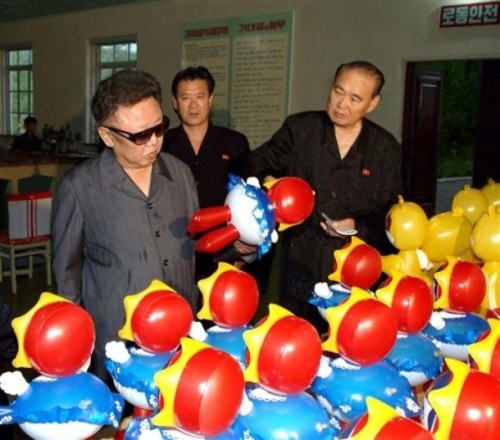
Why do I (and so many other people) find picture after picture of Kim Jong-Il Looking At Things so interesting?

Without speaking for others, I'll admit I'm worried. Maybe the Dear Leader is onto something about human nature.

The interesting thing is not what Kim Jong-Il is saying with his face, but what the people in the background are making of it.

What do the faces in the backgrounds of all these pictures say to you? To me, they show emotions ranging from worry to pleasure to glee that the Dear Leader is Looking at Their Things.

The Dear Leader never shows in these pictures anything but Curiosity or Pleasure at the Things at which he Looks. The people who are Looking at him Looking At Things clearly care what impression their Things make on Him, but feel more or less uncertain about it.

I think this is what fear does to people. I've seen that same look among students who have certain church-political commitments they think their lives depend upon. They come in my office and want to close the door and talk about what they really believe, in contrast to what their Dear Leaders insist they pretend to believe.

Being a Dear Leader is bad leadership. Effective, obviously, but no less bad for that.

If there were nothing else speaking for it, the looks on those faces in the background are a definitive case for freedom.

How could we have helped this departing professor?

There is another side to this story we do not know. An English professor enumerates the reasons she is leaving the professoriate. Many of her reasons circle around the idea of a broken system.

We do not know who she is or anything about her institution or her experience. We do know that no one sided explanation is ever sufficient. 

To what degree is it her, and to what degree is it really the culture of her institution or the larger system of higher education? I do not know.

I want to do whatever lies in my power to help the culture of higher education not do this to people. If they do it to themselves, it's on them. But here again, no one-sided explanations. 

What can we do to correct the institutional side of whatever leads to this kind of disaffection and bitterness?

My bias is that finding the right person or group to blame will not help. The solution will have something to do with building trusting relationships in which genuine communication can happen. 


(I do know I'm a pollyanna, by the way.)

Tuesday, January 4, 2011

No Limits

G.T. "Buck" Smith is the gold standard for relationship-based fundraising. For all practical purposes he's the inventor of modern major gifts fundraising, which is built around donors' relationships with the institution. Since 1977 he's brought that same skill to the president's office. This profile from the Chronicle of Higher Education is inspiring.

This is the best part:
"The underlying thing for me is relationships—hardly anything important happens that doesn't have to do with relationships," he says quietly one afternoon in his office. He is not talking just about cozying up to a wealthy donor or board chairman. He is talking about building connections to needy students, the lowliest employees, the local community. "It's getting to know people, being interested in them. … Life is built on genuine relationships, where trust and integrity are without question. When that is there, there are no limits."

Tuesday, December 21, 2010

Reading People with Bad Reputations

Yesterday I referred to a blog post by Michael Jinkins.

It occurred to me afterward that it's interesting that he's the only person I know who has expressed a deep interest in a figure even more problematic than my friend Talleyrand.

Michael has built much of his academic career on an effort to rehabilitate Machiavelli as a guide to contemporary leadership.

I've got to be in favor of that, right?

Wisdom about the Presidency

There is much wisdom from Michael Jinkins here. The new president of Louisville Presbyterian Theological Seminary is starting his presidency the way a wise minister starts a new pastorate, by visiting every spare minute:
The first goal I set after becoming president of Louisville Seminary was to visit with every current board member and every faculty member, all of our staff, and as many current students as are available, as well as many past members of the board, alums, pastors, other church leaders, and friends of our school, within the first year of my presidency. I am eight weeks into the project, and we are well on our way.
He is finding that the stereotypes some might have brought to the job do not apply. His experience reinforces the insight that it's crucial for the president to question his or her own assumptions. It's hard enough for a president to find out the truth without compounding the problem by failing to ask enough questions.

Wednesday, June 23, 2010

Synchronicity

Wendell Berry is a very important figure in my intellectual development. He gave quite a few hours of his life, which he was far from owing me, to the formation of my young mind in the late 1980s. I am deeply grateful. There are few people I respect and admire as much.

This wonderful gift notwithstanding, he is being petty, in my opinion, about this.

Wednesday, May 12, 2010

The donor database is the key to a good night's sleep

In a previous life, I was a pastor. Early on, a wise older minister let me know that, contrary to the reigning piety, it was irresponsible for a minister not to know who gave and how much. "You're responsible for this boat, and you've got to know who's floating it." Among other things, it makes it possible to sleep at night.

The reason, of course, is that too often people try to use money to manipulate mission. "If you don't ________, I'm going to withhold my giving." When someone says that, you have to know exactly what it means.

It happens in higher ed as well, unfortunately. But there's a difference. In higher education, there's no piety to overcome. Everyone knows or should know that there's a database at hand that stores the giving record of the one who is making the threat.

Dave Dunlop says somewhere that one of the first requirements of a good fund raiser is "a kind and forgiving nature." That's partly because people disappoint you all the time with their motives for giving and not giving. I've been told some doozies. And that's fine. The person who looked me in the eye last summer and told me he gives every year six times what I knew he really gave is still being generous in light of his resources. So a big thanks to him.

Recently I've been informed that two gifts, one of six figures and the other seven, have been "revoked" because of this and that. Thanks to this wonderful software product, I know that it takes me less than three days to earn in salary the combined total lifetime giving of these two friends of the institution. That doesn't mean we're not forgoing $1.7-million between them, but given what I know for sure, I can live with that uncertainty.

So I forgive them and I'll be kind to them. And I'll keep in touch with them, just in case. But tonight I'm going to get some sleep.

Tuesday, May 11, 2010

Cost Cutting and Faculty Unhappiness


I know nothing about the situation with cost cutting and faculty unhappiness at Wells College that I didn't read in this article. It may be that this faculty is completely in the right and the president is completely in the wrong. But I doubt it. I've seen some situations that were outwardly similar. At such times the president and cabinet are in a difficult spot. They are sure a fully democratic, shared governance approach can be abused to impede any action at all, and may not yield the hard decisions that have to be made, shared or not.

Since the administration does not in reality conform to the worst faculty stereotypes, they've been over everything sweating blood trying to find the least humanly and institutionally damaging things to cut. They might be wrong, but they're pretty sure they've found the least awful solution. Many smart and honorable people have worked on it, and they're confident this is what needs to happen.

But suppose you have a meeting, or series of meetings, anyway. Experience suggests that when we seek faculty participation in such a conversation as this, the result is not always a proposal that will cut costs, but rather an argument that cost cutting is unnecessary, or other things would be better to cut, or the development office should just raise more money. And those arguments may be valid. If they are, those approaches need to be pursued. That's why we have shared governance. "All of us are smarter than any of us." I am for it.

It's possible, though, that after the meeting, the cuts will still have to be made. And now the faculty are even angrier, because they provided an actual (perhaps non-cost-saving or more damaging) solution that results in no faculty cuts, which the administration then ignored.

It is easy to imagine that the president makes a calculation: maybe it's best for relationships with the faculty to let them object that they weren't consulted than to give them cause to feel patronized and rejected. It's a least of the evils situation, not a sign the president is an ogre. In this situation, the leader is in reality doing the opposite of what she's accused of: she's trying to preserve the faculty's opportunities, not limit them. From the faculty's point of view, though, it's easy to understand that they don't see it that way. In the long run, seeking consensus first is best.

The worst case scenario is one I've mentioned earlier: Gaye Tuchman describes a situation at Wannabe U. There was a meeting in which faculty input was to be invited concerning a hard decision The meeting was ignored and boycotted. Then when the administration went forward anyway, faculty members said they weren't consulted. Again, I don't know that any such thing happened at Wells and don't want to cast aspersions on this particular faculty.  But it does happen, and it's not surprising that such things lead administrators to go on and do what needs to be done by their best lights.

It's one of my deepest wishes that this divide that increasingly characterizes relationships between faculty and administration could be overcome. Where is Solomon when you need him? We could at least start by recognizing that both the faculty and administrators are acting in ways that make sense to them at the time. Utter perversity is extremely rare. It's best to assume honorable motives on both sides.

Wednesday, April 21, 2010

An Anti-Naming Opportunity

Alumni of the University of Alberta have given $20.5-million to avoid making their business school a corporate naming opportunity.

Good for them.

I am all for naming opportunities. People like to be recognized for their gifts. We can bemoan this as some kind of moral failing, but you can't build buildings or offer scholarships with moral pique.

Perhaps one day people will all become selfless and stop caring whether they will be thanked and honored for their generosity. Meanwhile there are students to educate, diseases to cure, stars to discover. So I expect we'll keep naming scholarships, laboratories, and and dorms after people and corporations.

It's a small step from there to realizing it's just as legitimate for 170 donors to come forward to meet an eight-figure goal to prevent the naming of a school after anything but the university.

Naming opportunities make a lot of things possible, and build important connections. Anti-naming opportunities do too.

Tuesday, April 20, 2010

Why Talleyrand?

For the second time I've been asked what it is about M. de Talleyrand I find attractive, so that I blog under his name. It’s a little surprising given Talleyrand’s reputation that the question isn’t asked more often. But perhaps not so many people know who he was anymore. A little of it is in my profile, but I’ll try to explain more fully.

My identification with Talleyrand is lighthearted, not as serious as my questioners have feared. He is not a hero or anything of the kind. I certainly do not aspire to grow more and more like him.

It’s just that one day in the early 2000s I was working on my doctoral thesis, which has to do with a theological issue in the eighteenth century. This inevitably involved a lot of reading and thinking about Enlightenment figures. Talleyrand appeared on my horizon. I realized then that while he was no angel, much of the gossip on which his reputation was based was not true (though some of it was). At the same time, I noticed certain common threads between his life and mine. It was just a quick, appreciative thought: I could sympathize with him and even understand  him, while acknowledging his flaws (and my own). He’s stayed with me ever since.

The Bonapartist sympathies of those who contributed most to forming Talleyrand’s reputation also help explain it. Few can admire both Napoleon  and Talleyrand. One or the other has to be a scoundrel. Thinking as I do that  the peace of Europe is of more value  than the glory of France, I take Napoleon for the scoundrel. Talleyrand did as much as any other one person to derail Napoleon’s warmongering. If you revere Napoleon’s memory or identify him with French glory, this looks like treason. Otherwise, not so much.

I do not intend to defend Talleyrand against every accusation. He was, by some modern lights and some in his own time, both venal and sexually undisciplined. It doesn’t help many feel better that in these ways he was fairly normal for his class, only he didn’t pretend to keep his vices secret. In his favor, we can say that he did a great deal of good for Europe with the wealth he pursued and acquired. And we can also say that his romantic involvements, especially from middle-age on, were almost exclusively  “affairs of the soul,” as David Lawday puts it. Even in his youth he didn't get around enough to justify fully the reputation he has for it.

Talleyrand had principles, and he was almost unerringly guided by them. The accusation that he was unprincipled, already leveled during his lifetime, was always groundless. It merely showed his accusers did not understand or share his principles. He was committed to the interests of France first (even when this meant subverting a particular government, or four); he was committed to a peaceful, prosperous, civilized Europe. He believed many things could be achieved by intelligent talk, and many more by intelligent silence.

There is much more, but this is enough for now.

David Lawday's Napoleon’s Master is a good recent guide for those who are interested in reassessing Talleyrand with the Bonapartist blinders off.

Wednesday, March 24, 2010

Fewer than Ten Influential Books

Bloggers are writing about their ten most influential books, I hear. I don’t know why. There may be at least a little interest in proving our intellectual bona fides: "I'm the sort of person who is capable of being changed by a book." Well, I am whether I blog about it or not, and whether anyone cares or not, so I’ll take a run at it.

Scott McLemee has a good point: influence and pleasure are not the same. A list of the books I found most enjoyable would be quite different from what follows. Perhaps I will make that list also, and see how it interacts with this one.

In no particular order, five books that have changed me, since I can't think of ten just now without dipping into a second tier of books less formative than these:

1. Mastering the Art of French Cooking, by Julia Child et al. This got hold of me before there was a Food Network, or at least before I knew about it. The mayonnaise recipe captured my imagination and my heart. Making mayonnaise was magic. French cooking has been through a revolution since it was published, a kind of Kantian turn to the ingredient, and I never cook from Mastering anymore, unless I’m making coq au vin, which I still love. I didn’t know about the turn to the ingredient when I discovered the magic of mayonnaise and of coq au vin, though, and this book inspired me to stop making it up as I went along and learn cooking for real.

2. The Irrelevant English Teacher, by J. Mitchell Morse. One of my parents, probably my mother (an English teacher when it came out), had this little volume on a bookshelf. When I picked it up, I was an adolescent student of some painfully relevant English teachers. That is, we spent most of our class time sharing our ignorance about what we called “issues.” Morse showed me it didn’t have to be this way just before I started AP English in my senior year of high school. That class brought a flesh and blood irrelevant English teacher into my life. Thanks to Morse, I knew how to appreciate her and finally started learning to read and write. (As a trailer for the "most enjoyable" list, in case it never gets made, I want to mention Stanley Fish's romp, Save the World on Your Own Time, which makes a similar argument.)

3. The Unsettling of America, by Wendell Berry. Ernest J. Yanarella, my Political Science advisor at the University of Kentucky, assigned Berry’s discussion of the loss of family farming in America for a seminar on food policy. (If I made a list of influential people, Yanarella would be on it, though I'm appalled at myself for not having talked with him since I graduated. In those days he was an intently counter-cultural academic. Now I see he has short hair and a tie, and sits on UK’s Board of Trustees. Amazing.) The Unsettling of America was important as much for bringing Wendell Berry into my life as for anything in the book. Berry's lucidity and independence of mind intrigued me. One day it dawned on me that he was on the faculty at UK, and would therefore have office hours. So I found his office and started talking with him. What we said and why it was important is another post, but let's just say the man is at least as lucid as his books.

4. The Nature and Destiny of Man, by Reinhold Niebuhr. “Man has always been his own most vexing problem.” Always will be. Two people can have a relationship and work things out. When a third joins them, you get politics. Politics is therefore unavoidable and should be approached with seriousness. But politics is never going to make things much better. This is a crucial line of thought for keeping my sanity.

5. The Fifth Discipline, by Peter Senge. There are many ways to learn there are no easy answers when you’re working with people. I finally got it for good by reading Senge. For a long time I kept a notebook, a kind of journal, where instead of writing I drew diagrams of situations. Having put so much energy into what I learned from Senge helps me see things like feedback loops, process delays, and unintended consequences. Sometimes that is like seeing the oncoming train when there's still time to get out of the way, which is hard to overvalue.
Thursday, January 7, 2010

Is High Division 1 Basketball Really This White?


This is the Duke University basketball team picture for the current season.

It is or ought to be self explanatory.

I do not understand how an institution in North Carolina — or anywhere in America — gets away with this.

For contrast, here is the official photograph of the current basketball team at the University of Kentucky, an institution whose alleged racism in the past was a major theme in a popular movie. (Full disclosure: I am a UK graduate.)


I count three dark faces in Duke's picture, perhaps four. Kentucky has three white ones. If this situation were reversed, would the media be silent? Would the NCAA? Would Congress?

Duke likes to think of their basketball program as "America's Team." But America's team doesn't look much like America, certainly not much like the teams who compete against them. Why are they not held accountable for this?

Monday, November 23, 2009

Good Question

The accrediting team evaluating one of our extension sites for degree-granting status asked me, "How do you relate your development function to student learning outcomes?"

You mean other than finding people who love to give scholarships so students can get into the path of some learning outcomes to begin with? Paying professors and utility companies so there's a teacher and a context for learning outcomes?

In other words, I was adrift on the sea.

But it's a question I'll think about for a while. Maybe someone will ask again once I've got a cogent answer.

Tuesday, November 3, 2009

Fundraising with African-American Alumni Is Good Fundraising

I took away from this  seminar that African-American donors will hold us accountable to many of the same standards as other donors, but more stringently.

If African-American possible donors see themselves in our fundraising materials, and if they are given evidence that the racism they have experienced from the institution is being dealt with, the rest is just good fundraising. They care more about personal connection and evidence of results than white donors do, but we should be prepared to offer those to everyone.

Actively working with African-American constituents, which is the right thing to do, will, in addition, have the effect of making the institution better at everything we do.

Monday, October 26, 2009

UK should accept this gift and use the controversy to teach about philanthropy

The University of Kentucky has its hands full with a naming opportunity. This is the kind of diplomatic challenge that makes administrative work so engaging.

Joe Craft, who gave the naming gift for the basketball practice facility at UK, has worked with twenty other coal industry players to assemble a $7-million package of gifts to build a new dormitory for the basketball program, to replace the aging Joe B. Hall Wildcat Lodge.

The group of donors has stipulated that the word "coal" must be included in the name of the dormitory as a condition of the gift. This is the rub that has lit up the phones.

A group of students has sent a petition to the trustees, urging them not to accept the gift with this condition. Their reasoning, according to the Lexington Herald-Leader, is that it "does not represent the feelings of all students."

A spokeswoman for the group of students is quoted as further arguing, "I think it shows that Kentucky is not committed to moving forward in terms of energy and new jobs for people in Eastern Kentucky," she said.

Others are worried about other things. Why would the university build this building when there is a hiring freeze in place? What about the $1.5-million the football program needs for a multi-purpose recruiting room?

However, most of the debate is about whether coal is good, bad, or indifferent. (The "indifferent" blogger is worried about euphony in the new name, which is a good point.)

Diplomacy is important in situations like this. Here are some things to consider:

  • While the students' objections, as they have expressed them, are irrelevant, it is both right and prudent to treat them with respect and help them understand the gift more fully. Eventually, some of the current students will be in a position to advance their own values with a seven figure gift. The sense they have, that UK is "their" university (so it seems relevant to them that this gift doesn't reflect their feelings), is a valid and strong foundation for their future relationships, as graduates and perhaps as major donors, to the University.
  • The question whether coal is good, bad, or indifferent is an opportunity to talk about other aspects of UK's mission as a land grant university, and about their "green" initiatives. Clearly, UK's mission nearly requires it to contest gently any flatfooted claim that coal is bad. However, they can point toward UK's role influencing a future in which coal's role or consequences are different. They can also highlight their mining engineering programs, focusing on mine safety, perhaps.
  • This attention to restricted giving creates an opportunity to highlight UK's willingness to work with donors, whose values are always widely diverse, to express what is important to them in advancing the mission of the institution. This is the only purpose for which this gift is offered. It is not an unrestricted $7-million that UK has chosen to use in this way. The only choice facing the administration and trustees is to build this dorm with this name, or to forego the gift. However, other gifts provide other opportunities to emphasize other donors' values, and UK is presumably open to those conversations also.
What should UK do? I think they certainly should accept the gift, since it addresses a genuine need consistent with their mission. At the same time, they should lead the story by talking clearly and abundantly about why they are doing so.

Thursday, October 22, 2009

Honor Among Thieves

The chancellor of the Texas A&M system, Michael McKinney, is indignant that the former president of the flagship campus, Elsa Murano, conducted a real search for a cabinet level officer.

The chancellor blames the ex-president for not keeping her word — he impugns her integrity — because she, in a moment of weakness, agreed to hire a predetermined, apparently unqualified candidate for a key job, but then rightly conducted a real search with a consulting firm and faculty input, and hired someone else.

She should have resigned rather than agreeing to hire the guy from Washington at the outset, no doubt.

Once she turned around and did the right thing, though, the chancellor should have been the one in an impossible position, at least apologizing and acquiescing. Instead, he's indignantly blaming her — for publication and from the comfort of the chancellor's office — for not keeping her word!

The indignant chancellor still has his job, and the ex-president is looking for what is next in her life.

Wrong, wrong, wrong.

Tuesday, October 20, 2009

Wannabe U 2

Almost two weeks ago, I promised a further post on Gaye Tuchman's Wannabe U, and I have worked over a draft much of that time. I'm not sure it's worthwhile to continue stewing about it.

Perhaps it's the fact that I'm in the administration now and have begun to see the world through those windows, but I'm skeptical that things could be as bad at Wan U as she suggests, so I am perplexed how best to respond.

Certain themes stay with me, though:

1. I suspect that behind much of her narrative there are a lot of faculty and administrators who are honorable people doing the best they can with their flawed selves in a stressed and stressful situation. If this is not true, and the environment really is as poisoned by self-serving cynicism on all sides as it looks in Tuchman's narrative, I can hardly believe anyone works there at all.

2. If the relationships at UConn (or wherever) really are that poisoned, and yet people who have choices do in fact continue to show up, I trust someone is working on finding a better way. If not, the place cannot survive much longer without imploding.

3. I want to shake some of the faculty members she describes, if they are as she describes them. Why do they not see that scholars who realize they can best use their gifts as administrators are not "failed academics" but academics who are contributing to the cause in a different way? Why would anyone expect a cabinet level administrator who has plenty of work of a different kind to do to be contributing new research? Why would you boycott the meetings where you can contribute input and have an influence, and then complain that you weren't consulted?

4. I want to shake some of the administrators she describes, if they are as she describes them. The institution is a stewardship we've been given, not a platform or a stage on which to present ourselves to an admiring world. If you treat an academic faculty like a battalion of infantry, it is no wonder they start shooting at you.

5. I agree with what I understand to be a premise of Tuchman's thinking about higher education: the faculty is the heart of the institution. The role of administrators is to create and maintain a culture in which they can thrive as teachers and researchers. Inevitably that sometimes means doing things the faculty find troubling. For example, faculty members who think teaching is an annoyance need someone to help them rethink that, in my opinion. That they don't want to rethink it doesn't change reality: you can't have a school without students.

I'm going to keep doing my bit of working and hoping and praying that faculty and administrators in America's institutions, whether they are Wannabes or not, can find a pattern of workable partnership in governance before the whole task of higher education winds up in the hands of stockholders.

Tuesday, October 13, 2009

Anybody want to move to New York?

What this and this may tell about the economy or the academic job market, I don't know, but  Cornell's hiring freeze has suddenly thawed. They have posted a breathtaking 139 new (mostly administrative) jobs so far today at Inside Higher Ed.

The decision process that opened this floodgate must have been fascinating.

Saturday, October 10, 2009

Never Thought of That

I've got to change the name of my blog. Google thinks it's a French langauge blog, because, of course, "Talleyrand in Academe" features a French historical figure and the title itself is in French.

So it will be just "Talleyrand: Negotiating Higher Education."

Friday, October 9, 2009

The more things change...

Gaye Tuchman's book has arrived, and I have read through it once. It gave me the sense of deja vu. We have seen a version of this argument before.

In my last post, I mentioned the question whether the book would be helpful if next year is not 1910. (It will, about which more in a later post.) At least we can say that if next year is 1910 Thorstein Veblen will be glad to have a commrade in arms.

Veblen created one genre with which Tuchman's book can be identified in 1918 with his "memorandum on the conduct of universities by business men" entitled The Higher Learning in America. He worried nine decades ago that, "Plato's classic scheme of folly which would have the philosophers take over the management of affairs has been turned on its head; the men of affairs have taken over the direction of the pursuit of knowledge" (57). He was bothered by "the incursion of business principles into university policy" (95).

Tuchman and Veblen are concerned about a strikingly similar list of issues, which are often even expressed in similar terminology. Here is a partial list:

  • The influence of accountants
  • "Auditing" and "Surveillance" by administrators
  • The role of money in decision making
  • The compromises student recruitment can entail
  • Underpaid and understaffed faculties, while the university is spending large sums on real estate
  • Presidents who are not contributing current research in their academic disciplines (!)
  • Administrations who buff up appearances rather than making actual improvements
  • The prominence of athletics and the salaries of coaches
There are important differences between the two books as well. For example Tuchman does not, as Veblen does,  include "undergraduate instruction" among the "extraneous activities" by which a university might allow itself to be distracted from its real work (12).  Also, the role of Tuchman's wannabe corporate managers is played in Veblen's book by the faculty of "lower" professional and technical schools (such as business, law, engineering, and divinity) who are interlopers in university governance, representing "the supercession of learning by worldly wisdom" (149).

Reading Tuchman's book alongside Veblen's from ninety-one years ago, at least we can say that the transformation of Wannabe U that is the focus of Tuchman's ethnography was probably at most a transformation from an older business-driven model to a newer one.

And Tuchman and Veblen agree that there is no way to take American institutions back to a time, if there was one, when commercial values did not influence them.